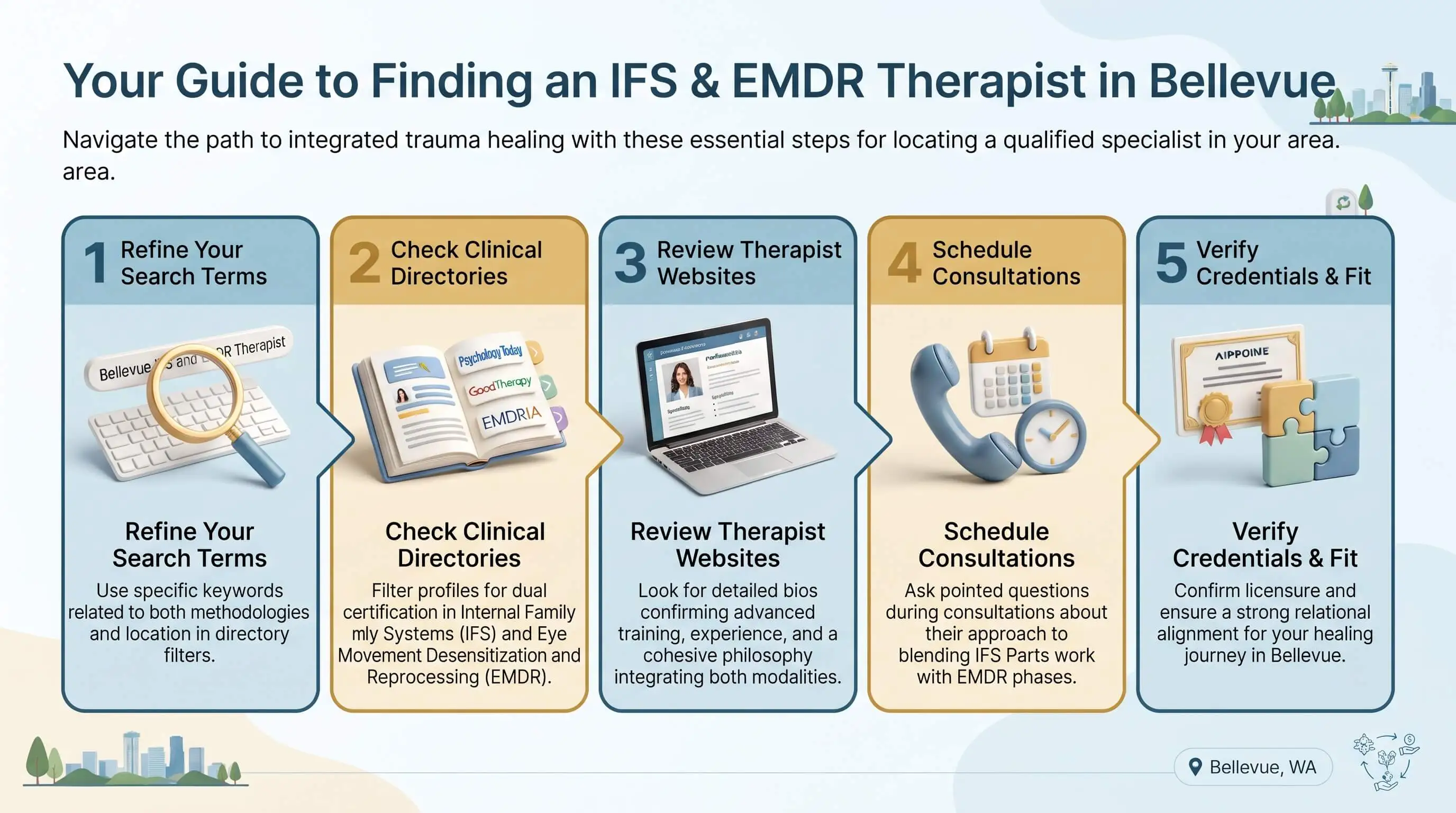
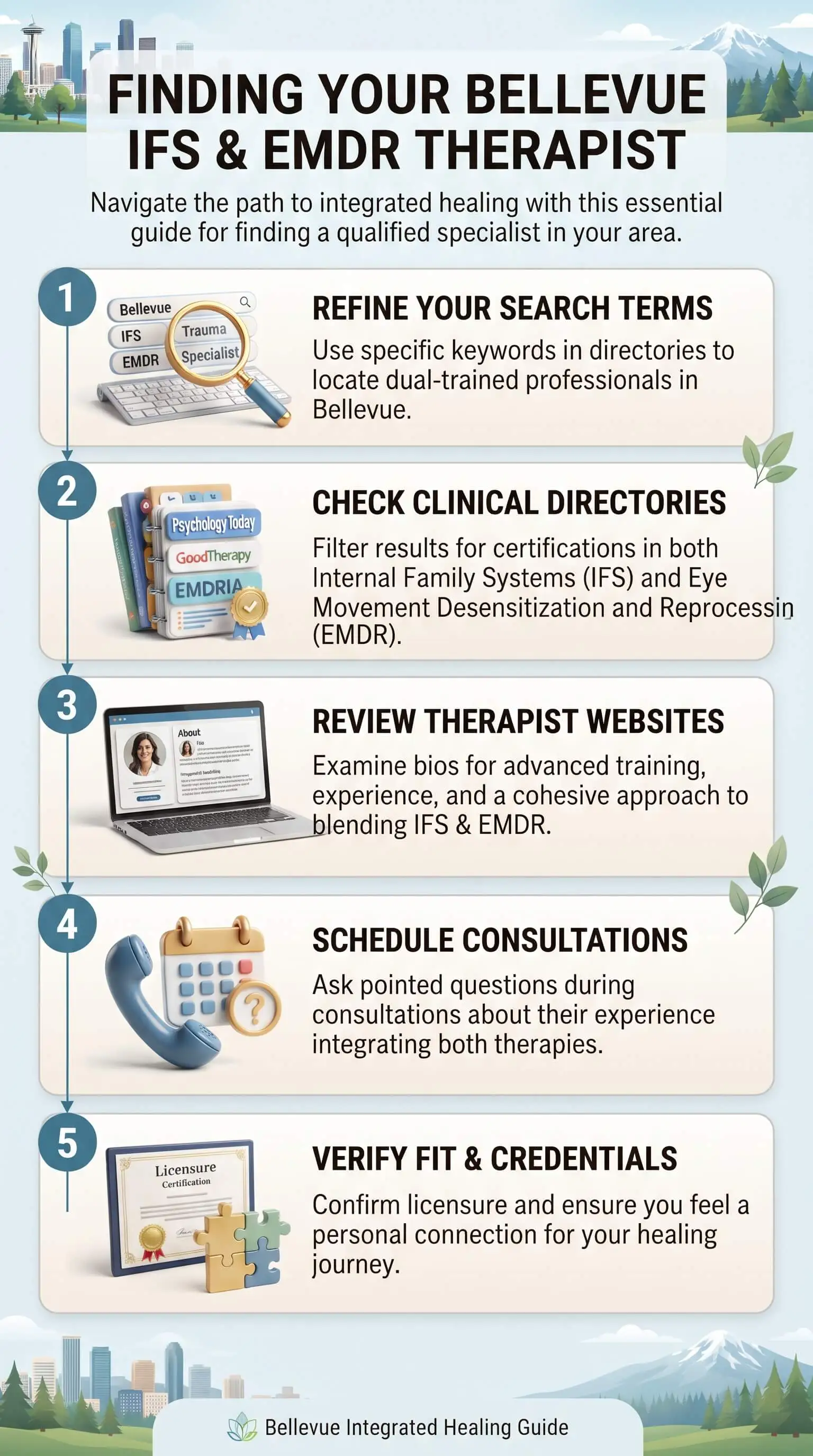
That’s usually when the search for IFS and EMDR together begins. To find a Bellevue therapist who combines them, look for a Washington-licensed clinician with IFS Institute training and EMDRIA-approved EMDR training. Ask how they decide when to use each one, then confirm their license with the state Department of Health.
Most of what you’ll read on this site is about wounds that heal in stages, where cleaning and protecting come before anything else. Emotional injuries often follow the same order, and some need room before anyone goes near them. That’s a big reason these two approaches get paired. Having IFS therapy explained can help you understand how these approaches work together. If you live in Bellevue or anywhere on the Eastside and talk therapy alone hasn’t moved much, this guide is for you. You don’t have to decide anything today.
TL;DR Quick Answers
IFS therapist Bellevue WA
Look for a Washington-licensed counselor trained through the IFS Institute who works with adults on the Eastside, either in person or by video. Bellevue’s in-person options often run waitlists, so online IFS opens the search to any clinician licensed in the state.
Who to look for: An LMHC, LMFT, LICSW or psychologist with IFS Institute Level 1 training or higher.
How to check: Confirm the license in the Washington DOH Provider Credential Search before you book.
What IFS helps with: Perfectionism, high-functioning anxiety, shame, complex trauma and burnout, starting with the protective parts behind them.
An online option: Lauren Rath Therapy offers 50-minute video IFS sessions for adults anywhere in Washington and is in-network with BCBS, Aetna, Regence, Premera and Cigna.
First step: Book a free 15-minute consultation and pay attention to how it feels. Choose on fit.
Top Takeaways
Check training in both models, and know the difference between trained and certified.
Verify any Washington license through the Department of Health before you book.
Ask how a therapist decides when to use IFS and when to use EMDR.
Starting with IFS alone is a valid path, especially for long-running patterns.
Online care opens up every Washington-licensed clinician, not just the ones with a Bellevue office.
What Do IFS and EMDR Each Do?
IFS, short for Internal Family Systems, treats the mind as a group of parts. Some parts protect you. Others carry older pain. Underneath all of them sits a steady, curious center that IFS calls the Self.
Think about the part that keeps you overworking, or the one that braces for criticism before anyone has said a word. In IFS, that part is doing a job it picked up a long time ago, and the work starts by understanding that job before asking the part to change anything.
EMDR, or Eye Movement Desensitization and Reprocessing, is more structured. It moves through eight phases. During reprocessing, your therapist uses bilateral stimulation such as eye movements or taps while you hold a hard memory in mind, and over time the memory tends to lose its charge. Researchers consider EMDR an evidence-based treatment for PTSD.
IFS
Main focus: Your relationship with protective and hurting parts
Pace: Slow and led by you
What a session feels like: Conversational and inward-focused
Often a fit for: Shame, perfectionism, inner conflict, long-running patterns
EMDR
Main focus: Specific distressing memories
Pace: Structured phases
What a session feels like: Preparation, then focused sets of bilateral stimulation
Often a fit for: Single-incident trauma and PTSD symptoms
IFS-informed EMDR
Main focus: Memory reprocessing with your parts on board
Pace: Structured, but slowed wherever a part needs it
What a session feels like: Checking in with parts before, during and after processing
Often a fit for: Trauma where a protective part blocks or stalls processing
Why Do Some Therapists Combine IFS and EMDR?
EMDR helps you move through a memory, while IFS helps with what happens when part of you won’t go near it.
That second situation comes up often. In standard EMDR, processing can stall or loop, and a protective part is frequently the one pumping the brakes. A therapist trained in IFS slows down and asks that part what it’s afraid of instead of pushing past it. Many ask protectors for permission before reprocessing starts, then check back in with them before the session ends.
Know two things before you search. IFS-informed EMDR is a clinical blend rather than its own certified therapy, so no single credential proves someone does both well. And the research on combining them is still young. A 2025 paper in Discover Psychology points out that the evidence for EMDR, strong for PTSD, doesn’t yet extend to complex and severe trauma. That gap is one reason clinicians turn to parts work there.
What Training Should a Combined IFS and EMDR Therapist Have?
You can verify each layer below, and it’s worth checking all of them.
EMDR training. A clinician who finishes EMDRIA-approved Basic Training is considered EMDR trained. EMDRIA Certified Therapist is a separate, advanced credential with its own application, added consultation and continuing education. Training is a solid baseline. Certified tells you they’ve gone further.
IFS training. The IFS Institute runs Level 1, 2 and 3 training and treats certification as a separate step on top of them. To certify, a therapist needs Level 1 plus Level 2, or a Level 1 completed as a program assistant. They also need at least two years and 200 hours of IFS practice after Level 1, with an approved consultant signing off. The IFS Institute Certification Policy spells out the details.
A Washington license. Look for an LMHC, LMFT, LICSW or licensed psychologist. The Washington State Department of Health Provider Credential Search lets you confirm any license by name and shows any disciplinary actions on record.
Search for an EMDR therapist in Bellevue and you’ll find plenty of directory profiles listing IFS and EMDR side by side. A listing won’t tell you how much training sits behind it, so ask which level they’ve completed in each.
What Should You Ask in a Free Consultation?
Most Eastside therapists offer a short free call, and it’s worth using well. The National Institute of Mental Health recommends asking about credentials, approach, goals and fees, and it calls rapport and trust essential.
What IFS training have you completed, and are you certified?
Are you EMDR trained or EMDRIA certified?
How do you decide when to use IFS and when to use EMDR?
What happens if part of me doesn’t want to go near a memory?
How do you help me settle if I get overwhelmed in session?
Do you see clients in person, online or both?
Are you in-network with my insurance, and if not, what does a session cost?
How will we know it’s working?
Notice how the call feels, too. Feeling rushed tells you something. So does hanging up a little more settled than when you dialed.
Should You Start With an IFS Therapist in Bellevue, WA?
You don’t need both methods at once. Plenty of people start with IFS alone and spend the first stretch of therapy building trust with their protective parts. For some, that’s enough. Others add EMDR later, with the same clinician or with a second one who coordinates care.
IFS often makes a good first step when what you’re carrying feels more like a pattern than a single memory. Perfectionism, high-functioning anxiety, shame that shows up out of nowhere and burnout that a long weekend doesn’t touch all fit that description.
If that sounds familiar, working with an IFS therapist Bellevue WA residents can see by video is a reasonable place to begin. Lauren Rath Therapy offers 50-minute online IFS sessions for adults anywhere in Washington with Lauren Rath, MA, LMHC, an IFS Institute Level 1 trained counselor. The practice is in-network with BCBS, Aetna, Regence, Premera and Cigna.
In Person or Online on the Eastside?
Bellevue has a good number of trauma-trained clinicians. Many of them run waitlists or keep in-person hours a couple of days a week.
Telehealth opens that up. Any clinician licensed in Washington can see you by video, whether you’re in Bellevue, Redmond, Kirkland, Sammamish or Seattle, and you skip the drive on 405 entirely.
IFS works well over video because the work happens on the inside. Clinicians can deliver EMDR online too, using on-screen or self-guided bilateral stimulation, but ask any EMDR therapist how they handle it before you book.
“When someone tells me EMDR stalled for them, I don’t hear about a failed treatment. I hear a protective part doing its job, usually one nobody asked whether it was ready. In my sessions, that part gets asked first. Some protectors say yes within a few weeks, and some need months. I follow their timeline, not mine, because in my experience that’s what makes the deeper work feel safe enough to keep going.”
7 Essential Resources
NAMI HelpLine: Free peer support, information and resource referrals, Monday through Friday from 10 a.m. to 10 p.m. ET. Call 1-800-950-NAMI (6264) or text “HelpLine” to 62640. It isn’t a crisis line.
988 Suicide & Crisis Lifeline: Call, text or chat 988 any time, day or night, if you’re in crisis.
EMDRIA: Training vs Certification: Explains what “EMDR trained” and “EMDRIA Certified Therapist” mean.
IFS Institute Certification Policy: Lays out the IFS training levels and what certification takes.
Washington DOH Provider Credential Search: Confirm any Washington clinician’s license and check for disciplinary history.
NIMH: Psychotherapies: A plain overview of therapy types and what to ask before you start.
CDC: Adverse Childhood Experiences: Background on how early experiences shape adult health.
These seven essential resources help individuals find mental health support, understand trauma and therapy options, verify the qualifications of healthcare professionals, and access trusted information on EMDR, IFS therapy, childhood experiences, and crisis services.
3 Statistics
63.9% of U.S. adults reported at least one adverse childhood experience, and 17.3% reported four or more, according to CDC Behavioral Risk Factor Surveillance System data from 2011 to 2020. Hard early experiences are common, and needing help with them isn’t a personal failing.
Half of all lifetime mental health conditions start by age 14, and 75% by age 24, per NAMI. That’s why adult trauma work so often reaches back to younger parts.
At least two years and 200 hours of IFS practice after Level 1 is what the IFS Institute requires for certification. Keep that number in mind when you compare “trained” with “certified.”
Just as silver nitrate in treating various skin conditions requires appropriate professional care, healing childhood trauma calls for qualified mental health support, especially since adverse childhood experiences are common, many mental health conditions begin early in life, and certified IFS therapists must meet specific training and practice requirements.
Final Thoughts and Opinion
The “IFS and EMDR” label matters less than most directory searches suggest.
What matters more is how a therapist treats the part of you that hesitates. Some get curious about it. Others try to work around it, and you can usually tell which kind you’re talking to within one call. A clinician with deep IFS training and no EMDR may serve you better than someone who lists both after a weekend workshop, though the reverse can happen too.
Check credentials first, since they’re easy to verify. Then trust what you notice in that first conversation. If you’re weighing an IFS therapist in Bellevue, WA against someone who lists both methods, ask them the same questions and pay attention to who listens best.
Wounds that get rushed tend to reopen, and the ones you can’t see are no different.
Frequently Asked Questions
Can one therapist do both IFS and EMDR?
Yes. Many clinicians train in both and blend them, an approach often called IFS-informed EMDR. Nobody issues a single credential for the combination, though. Ask about their IFS Institute training level and whether they’re EMDR trained or EMDRIA certified, then ask how they decide which method to use and when.
Is IFS-informed EMDR better than EMDR alone?
Not necessarily. It depends on what you’re working with. EMDR on its own has strong research support for PTSD, and adding IFS can help when protective parts stall processing or when trauma is complex. Research on the blend is still early, so fit and pacing matter more than the label.
What’s the difference between EMDR trained and EMDRIA certified?
EMDR training means a clinician completed EMDRIA-approved Basic Training. EMDRIA Certified Therapist is a separate, advanced credential that requires its own application, extra consultation and continuing education. Both can practice EMDR, but certification signals more supervised experience.
How do I know whether a therapist is IFS certified?
Ask them directly, and check the IFS Institute directory. Certification requires Level 1 and Level 2 training, or Level 1 as a program assistant, plus at least two years and 200 hours of IFS practice after Level 1. Plenty of skilled therapists hold Level 1 or Level 2 training without certification.
Does insurance cover IFS or EMDR in Washington?
Often, yes. Therapists usually bill both as outpatient psychotherapy, so coverage depends on your plan and whether the therapist is in-network. Call your insurer about outpatient mental health benefits, then confirm network status with the therapist before your first session.
Can IFS or EMDR be done online?
Yes. IFS works well by video because the work happens internally. Therapists can deliver EMDR online too, using on-screen or self-guided bilateral stimulation. In Washington, any licensed clinician can see you by telehealth anywhere in the state.
What should I do if I need support before I find a therapist?
The NAMI HelpLine offers free peer support and resource information on weekdays from 10 a.m. to 10 p.m. ET. Call 1-800-950-NAMI (6264) or text “HelpLine” to 62640. If you’re in crisis, call or text 988 any time.
Not Sure Where to Start?
If IFS feels like the right first step, Lauren Rath Therapy offers a free 15-minute video consultation for adults anywhere in Washington. You won’t fill out a form first. You’ll just talk through what’s going on and whether working together feels like a good fit.
